I have heard a lot of libraries from a lot of different types of libraries say smugly or proudly that they don't shelve books. That's a clerk's job.
Sure, clerks were indeed hired to reshelve, check patrons out and do other tasks that it doesn't require a degree to do. That frees up librarians to do more complex tasks like reference work, instruction and purchasing. That's what we get paid the big bucks (ok, moderate, non-inflation adjusted bucks) for!
But there is value to pitching in with those more mundane tasks on occasion. It's not only good for staff morale, to know that librarians will come down from their lofty chairs at the reference desk to help reshelve the 300 or so children's picture books that were returned just before story hour. And patrons see our shiny happy faces in other places in the library. They have increased confidence in us because they know (and we know) that we are capable of doing anything in the library, including being able to replace a lost card while the clerk is away from the circulation desk. It means that we're open to all of our customers' needs, and they don't need to be shy to ask, because they may be asking the "wrong" person for help with a particular thing.
It gives us more opportunities to interact with customers. When we check out their books, we see tangibly what particular patrons are interested in, and what is circulating. When we shelve books, we also see what is circulating, and we also see what materials are NOT. It can help us come up with strategies either for weeding, or for promoting lost gems.
Going into the stacks for more than just pulling books provides exposure--patrons see us out and about (thus making us less intimidating), but it exposes us to how the patrons are using our collection. Are they NOT checking out graphic novels, but there are plenty of patrons sitting in various nooks and crannies, polishing off Strangers in Paradise and Blackest Night? Are they not using the furniture for its intended purpose? Are there places that need furniture, or spaces opened up?
Getting out in the stacks, and out of the common areas can give insights into all this. When we walk through common areas without actually "using" the library, we don't see what patrons see--we see what we intended them to see, regarding configurations and the environment. Is it super-convenient to have chairs on the end of (or in the middle of) rows? Do you often find patrons sitting with a multitude of books on the floor, between the wall and the last row of books? Is it because the nearest table is too far away?
And patrons can ask questions they might not have asked otherwise. They may decide going to another floor, or another part of the building to ask the reference desk a question is too far to go, and may frustrate themselves further by looking for things (thus creating a negative connotation with the library in their mind), or they may just forget about it, and skip getting information or resources that a librarian could have easily provided.
Getting out and about gives us opportunities to connect with our customers in new ways too--if you see someone grabbing the second book in a series, you can ask if they've read the first. They may no know they're looking that "Bloody Red Barron" is the follow-up book to "Anno Dracula," and they'll be disappointed a few chapters in, to make that discovery--and even more disappointed when Anno Dracula has been checked out by the time they return. This makes them feel like they can't navigate the library, and it's too difficult, and so they'll just go to Amazon--or if they don't have the money, go to nothing at all for those resources.
Say your patron HAS read Anno Dracula. Have you read it too? Can you have a conversation about it? Can you find out what other things they like to read? Maybe they have a complain that they love steam punk fiction, but your library has none, and so they have to borrow or buy all of that stuff on their own, and the only thing they check out at your library is the vampire fiction. Maybe they've heard others complaining about the way the science fiction section is organized, and feel that since there is so much fantasy, it should have its own section, or a sticker to denote that it's fantasy, and not scifi. Maybe they really like the layout of the Young Adult room, and wish adults had a space like that, too.
Librarians do most of their work based on best guesses. We look at statistics and user behavior and make a best guess as to what a popular book or collection would be, what would be the best way to lay out space and organize collections, etc. But we don't really know first-hand. We pour over our statistics (which is right and good--most organizations, libraries included, live and die by statistics), but there are so many things our statistics CANT tell us. They can't tell us about items we DONT have, and how they would be received by patrons. They can't tell us that people absolutely hate those hard backed chairs, and prefer stools. They can't tell us that no one actually uses the study rooms, except to make out in.
Won't patrons say something to us about this stuff, if it's important? Maybe. Maybe they don't think it's important enough to mention. Maybe they think it's not important enough to US, for them to mention. It may slip their mind, or they may assume we just don't operate that way. Getting out there to shelf read, or reshelf books, or to weed gives an opportunity for insightful conversation, and off-handed gems of knowledge. It lets us develop real relationships with customers, instead of just an information exchange transaction at the reference desk.
It makes us look friendlier, it may even make us BE friendlier, since we know our patrons are keeping an eye on us all the time. We may develop real friendships. Shy or reluctant patrons may grow in confidence that we're here for them, and we're not a hurdle to get past.
Plain and simple, people need a reason to come back. We need to show them why we're of value, and help them feel welcome and important to us. Making ourselves more visible and more approachable is a terrific first step. Seeing how patrons behave with our space and our collections "in the wild," is invaluable because it helps us calculate future improvements. At the end of the day, good mojo begets good mojo--patrons who feel cared for both in the type of materials and the type of services we provide will come back, and tell others. And that's just good advocacy.
Showing posts with label advocacy. Show all posts
Showing posts with label advocacy. Show all posts
Monday, September 26, 2011

Wednesday, August 3, 2011
What librarians do all day
So... The Atlantic a segment called "Tell Me What People Don't Understand About Your Job." It's a lovely and amazing outlet--NO ONE seems to understand what we do. I wrote a general post about what
So here is my response:
I forgot to add... I don't remember when the last time I "read" a book for pleasure. I usually listen to audios so I can be doing something else. Usually, it's mowing the grass. I have a manual human-powered lawn mower, so it's quiet enough, and I take advantage of the "me" time. Other than that... Not much time for reading in this field, or life in general at the moment.
So here is my response:
There is SO much people don't understand about being a librarian. I blog about it often. Probably the silliest misconception is that we aren't information professionals--we're just people who like books, and we spend our time reading all day. There are so many specialties in library science. Being a public librarian means being an information professional, teacher, marketer and social worker. Being an academic and special librarian means being fluent with new technology enough to implement technology changes in the library AND instruct others, researcher, instructor, cataloger, historian, archivist... The list goes on. We are futurists--we have to anticipate what new technology and what library materials will be good for users based on past performance. We need to be problem-solvers. We need to be advocates and get out into the community to explain what services we have, and explain why we're important and worthy of funding. We deal with politicians, school and organization officials, alumni, military people, accountants, lawyers, avid readers, authors and presenters, new mothers, car repair hobbyists, people needing tax or resume/job hunting help, the tech savvy, the computer illiterate, small children, young adults, teachers, parents, retired people, people with social problems (drugs, homelessness, trouble interacting with people, etc)... and every single person we deal with, whether we need something from them, or they need something from us, gets a smile and a professional demeanor. We find information, which sometimes means being creative in our research methods. We teach people, we help them find information independence, we bridge the digital divide for those who lack the resources and skills. We also repair our own computers and printers, program web pages, do building maintenance, set up databases, do our best to always do MORE with ever-decreasing funds and always try to be a good steward of taxpayer/tuition/organization money.We are always learning to stay abreast of the constantly changing technology and best-practices. We work long and hard to help patrons who walk through our doors, and those a world away with a research question that only OUR archive can answer. We make decisions about what is important to our culture and our collection when thinking about what to save and what to "pass on," both for our collections and archives. We have to decide NOW what will be important DECADES from now to a single researcher. We give young minds a thirst for knowledge and learning, and the tools to learn independently. We also clean up vomit, fix broken sidewalks and sit on city/university/organization committees, trying to make the world a better place.
...
But yeah... librarians just read all day.
I forgot to add... I don't remember when the last time I "read" a book for pleasure. I usually listen to audios so I can be doing something else. Usually, it's mowing the grass. I have a manual human-powered lawn mower, so it's quiet enough, and I take advantage of the "me" time. Other than that... Not much time for reading in this field, or life in general at the moment.
Wednesday, June 15, 2011
Want more money? Ask!
My friend and editor, the ever-amazing currator and librarian extraordinare (why yes, I AM kissing up... however did you guess?) Lynne Thomas wrote a great blog post about something librarians, especially FEMALE librarians have trouble with--salary negotiation.
I'm guilty of this myself--I was raised in an Italian-American household where it was rude to "put anyone out" by asking for anything they weren't willing to give you already... especially if you were a girl. Be polite, be gracious, and don't rock the boat.
I think that while women have come a long way in the last hundred years, librarianship is still viewed as a "woman's profession," like nursing and teaching, and therefore automatically does not command the respect it deserves. It was viewed as a job for spinsters, older ladies, and a job that women would do until they were married or pregnant, then quit. Also, the stigma is attached to many professions traditionally staffed mostly by women--it's not intellectually rigerous or "important," since it's not "man's work." No one will say that out loud today (if they have any sense, at least) but that latent attitude still colors how people view the monitory worth of those professions.
Lynne makes a great point that negotating salary helps YOU get more money, but it also helps the profession, and other librarians. It does this by bringing up the base salary, and stating to hiring institutions that librarians, professionals with masters degrees (and sometimes loads of student loan debt), experience and smarts are worth more. It helps institutions and local governments accept the reality that they WONT find a serious, skilled professional to do the job of librarian for less than a livable wage.
I learned so much at my first librarian job, but they kept me at 35 hours a week, and well below an actual livable wage because they DIDN'T value professionals. In fact, I sought employment elsewhere when they went from wondering why they needed someone with a masters to do the job to wondering why they couldn't just staff the library entirely with volunteers. I saw the writing ont he wall then. The library's board was full of people who DID care about the library, and they weren't being malicious. They just genuinely did NOT understand what a librarian did, and the value of having someone with education and experience in the position.
So read Lynne's post, and practice these three important sentences:
"I'm really excited about this opportunity. However, the offer is a little below my range. Can we do any better, say [name a number $5000 more than offer on table?]"
Don't just do it for yourself, but do it for the profession and for advocacy!
I'm guilty of this myself--I was raised in an Italian-American household where it was rude to "put anyone out" by asking for anything they weren't willing to give you already... especially if you were a girl. Be polite, be gracious, and don't rock the boat.
I think that while women have come a long way in the last hundred years, librarianship is still viewed as a "woman's profession," like nursing and teaching, and therefore automatically does not command the respect it deserves. It was viewed as a job for spinsters, older ladies, and a job that women would do until they were married or pregnant, then quit. Also, the stigma is attached to many professions traditionally staffed mostly by women--it's not intellectually rigerous or "important," since it's not "man's work." No one will say that out loud today (if they have any sense, at least) but that latent attitude still colors how people view the monitory worth of those professions.
Lynne makes a great point that negotating salary helps YOU get more money, but it also helps the profession, and other librarians. It does this by bringing up the base salary, and stating to hiring institutions that librarians, professionals with masters degrees (and sometimes loads of student loan debt), experience and smarts are worth more. It helps institutions and local governments accept the reality that they WONT find a serious, skilled professional to do the job of librarian for less than a livable wage.
I learned so much at my first librarian job, but they kept me at 35 hours a week, and well below an actual livable wage because they DIDN'T value professionals. In fact, I sought employment elsewhere when they went from wondering why they needed someone with a masters to do the job to wondering why they couldn't just staff the library entirely with volunteers. I saw the writing ont he wall then. The library's board was full of people who DID care about the library, and they weren't being malicious. They just genuinely did NOT understand what a librarian did, and the value of having someone with education and experience in the position.
So read Lynne's post, and practice these three important sentences:
"I'm really excited about this opportunity. However, the offer is a little below my range. Can we do any better, say [name a number $5000 more than offer on table?]"
Don't just do it for yourself, but do it for the profession and for advocacy!
Monday, June 6, 2011
Can I interest you in a rant about authoritarian school districts?
**update** somehow the wrong video got embedded. Seriously, I have no clue how that happened. Sorry! But, uh, the Batman fan film is awesome, if that's the post you saw first ;)
So, this school district suspended this kid indefinitely, just before graduation time, for posting things to his personal YouTube account...outside of school and outside of school hours. Way to be counter-productive, guys!
(Beware: curse words)
So, this school district suspended this kid indefinitely, just before graduation time, for posting things to his personal YouTube account...outside of school and outside of school hours. Way to be counter-productive, guys!
(Beware: curse words)
Wednesday, June 1, 2011
Where in the world have I been? -or- What you can do for your library.
I wonder that too, sometimes. I was off at an interview for a very cool job (pick me! pick me!) and at a science fiction convention. Now I have returned, and it's time to talk about what you can do for your library!
Sure, I talk about what librarians can do to advocate for ourselves and our profession, but there're things you can do as well!
This post is inspired by a comment from a friend that he supports libraries but hasn't stepped into one in years.
There're tons of excuses: libraries don't have what I like to read, I can afford to buy it on Amazon and not have to worry about late fees, I haven't been inside one in so long I don't know where to start...
All easily solvable, my friends! For instance... don't know where to start? Ask a librarian. Be frank. Admit you haven't been in a library since your senior year of high school, AND your librarian was mean. Most of us are very nice, and extremely understanding of fallen-away library users. Tell the librarian what your interests are, so that he or she can direct you to the sections you'll find most useful. Wanna check out DVDs, games, and graphic novels? We can help. Most libraries have DVDs and graphic novels, and many have games available for checkout or low-cost rental. Want books about waste removal systems in antiquity? We can tell you what Dewey range will set your heart aflutter. We can show you how to use our online catalog and give tips for finding exactly what you want.
The second biggest excuse is that libraries don't have what fallen-away library users like to read. First... do you really know that for sure? Or are you basing this on the one library you walked into in 1991 that had a scifi section entirely littered with young adult fiction and TV tie-in novels? Did that comment hit too close to home? Yeah, I thought it did :)
Really check out your library. Wander the shelves. You may happen upon old favorites and new finds you didn't know existed, or forgot about ages ago. Don't see what you're looking for on the shelf? Try the catalog. It may be checked out, or on order. Really, REALLY don't see what you're looking for? I have two solutions:
1) Suggest the library purchase it. Libraries have tight budgets and may not be able to order everything patrons request, but are often very open to suggestions. Often when we do ordering, we do it based on what has checked out well in the past, and what we THINK will be a hit. Hearing directly from the patron's mouth that he or she would love to check out more George R. R. Martin books tells us EXACTLY what will check out.
2) If the library is unable to purchase the book, ask if the library participates in Inter-Library Loan. Yes, libraries borrow books from other libraries. WE LIVE IN THE FUTURE, MAN. Don't see Game of Thrones? If a library that participates in our ILL consortium does have it, we can usually borrow it at no cost to you. Some consortiums are county or state wide. Some exchange with other academic institutions, or can even borrow nation-wide. What're the odds that NO library will have the book you're looking for? Probably pretty slim.
Why bother with all of this stuff, anyways, you're asking me. You can afford these things on Amazon. The first reason is that you don't always HAVE to buy everything off of Amazon. Nor do you always have to wait. A lot of these books are sitting on the shelf in your library. We also have other stuff you may not be able to find on Amazon: periodical subscriptions, old records and newspapers, database and journal access, story time, author visits, community events, opportunities for enrichment and learning that can't be found in the pages of a book, and above all...friendship. You'll meet so many people at your library, both patrons and staff. Way more than you'll meet by clicking "checkout" on your Amazon cart.
But there's another important reason:
BY CHECKING BOOKS OUT OF A LIBRARY, YOU ARE HELPING TO SAVE THAT LIBRARY. Even if you don't need the library, your act of checking out materials is SAVING LIBRARIES for people who DO need that library, sometimes desperately.
Why?
Libraries live and die by statistics. One of the most important being usage statistics. Every book, video or Playaway audio book you check out counts as a checkout for your library. Every time you walk in the door, a record is being kept of another patron walking in the building. Every time you sign up for a card, or renew your card, you're being counted as another person in your area that USES the library. Every question you ask at a reference desk is being counted by someone. Every time you make use of the photocopier, every time you bring a child to story time. Every time you do all of these simple things, which your tax or tuition money is already paying for, you are helping that library obtain more funding for people, facilities and materials. HOLY CRAP. YOU CAN COME TO THE LIBRARY, USE OUR STUFF FOR FREE, AND ACTUALLY BE HELPING US BY DOING IT. Like I said, we live in the future, man.
So, be a friend to your library! Come in, use our bathroom, leech our wifi and check out DVDs that exist soley for the purpose of rotting your brain cells. Check out a comic book. Photocopy something. Ask us about ancient toilet design. In fact, ask us pointless questions. No, really. Ask us pointless questions--the more, the better. In fact, walk away for a few minutes, then come back and ask us another, so we can count it as two reference interviews. We like it like that, because THAT IS HOW WE ROLL.
And maybe, if you want some help with research regarding a disease you've been diagnosed with, or are looking for old newspaper articles from that time when you were in the high school musical, or just want to know about sewage treatment in antiquity because it's been bugging you for a while, ASK US. We would be thrilled and honored to help!
SAVE YOUR LIBRARY. USE THEIR STUFF.
Sure, I talk about what librarians can do to advocate for ourselves and our profession, but there're things you can do as well!
This post is inspired by a comment from a friend that he supports libraries but hasn't stepped into one in years.
There're tons of excuses: libraries don't have what I like to read, I can afford to buy it on Amazon and not have to worry about late fees, I haven't been inside one in so long I don't know where to start...
 |
| LOOK, ROMAN TOILETS! |
The second biggest excuse is that libraries don't have what fallen-away library users like to read. First... do you really know that for sure? Or are you basing this on the one library you walked into in 1991 that had a scifi section entirely littered with young adult fiction and TV tie-in novels? Did that comment hit too close to home? Yeah, I thought it did :)
Really check out your library. Wander the shelves. You may happen upon old favorites and new finds you didn't know existed, or forgot about ages ago. Don't see what you're looking for on the shelf? Try the catalog. It may be checked out, or on order. Really, REALLY don't see what you're looking for? I have two solutions:
1) Suggest the library purchase it. Libraries have tight budgets and may not be able to order everything patrons request, but are often very open to suggestions. Often when we do ordering, we do it based on what has checked out well in the past, and what we THINK will be a hit. Hearing directly from the patron's mouth that he or she would love to check out more George R. R. Martin books tells us EXACTLY what will check out.
2) If the library is unable to purchase the book, ask if the library participates in Inter-Library Loan. Yes, libraries borrow books from other libraries. WE LIVE IN THE FUTURE, MAN. Don't see Game of Thrones? If a library that participates in our ILL consortium does have it, we can usually borrow it at no cost to you. Some consortiums are county or state wide. Some exchange with other academic institutions, or can even borrow nation-wide. What're the odds that NO library will have the book you're looking for? Probably pretty slim.
Why bother with all of this stuff, anyways, you're asking me. You can afford these things on Amazon. The first reason is that you don't always HAVE to buy everything off of Amazon. Nor do you always have to wait. A lot of these books are sitting on the shelf in your library. We also have other stuff you may not be able to find on Amazon: periodical subscriptions, old records and newspapers, database and journal access, story time, author visits, community events, opportunities for enrichment and learning that can't be found in the pages of a book, and above all...friendship. You'll meet so many people at your library, both patrons and staff. Way more than you'll meet by clicking "checkout" on your Amazon cart.
But there's another important reason:
BY CHECKING BOOKS OUT OF A LIBRARY, YOU ARE HELPING TO SAVE THAT LIBRARY. Even if you don't need the library, your act of checking out materials is SAVING LIBRARIES for people who DO need that library, sometimes desperately.
Why?
Libraries live and die by statistics. One of the most important being usage statistics. Every book, video or Playaway audio book you check out counts as a checkout for your library. Every time you walk in the door, a record is being kept of another patron walking in the building. Every time you sign up for a card, or renew your card, you're being counted as another person in your area that USES the library. Every question you ask at a reference desk is being counted by someone. Every time you make use of the photocopier, every time you bring a child to story time. Every time you do all of these simple things, which your tax or tuition money is already paying for, you are helping that library obtain more funding for people, facilities and materials. HOLY CRAP. YOU CAN COME TO THE LIBRARY, USE OUR STUFF FOR FREE, AND ACTUALLY BE HELPING US BY DOING IT. Like I said, we live in the future, man.
So, be a friend to your library! Come in, use our bathroom, leech our wifi and check out DVDs that exist soley for the purpose of rotting your brain cells. Check out a comic book. Photocopy something. Ask us about ancient toilet design. In fact, ask us pointless questions. No, really. Ask us pointless questions--the more, the better. In fact, walk away for a few minutes, then come back and ask us another, so we can count it as two reference interviews. We like it like that, because THAT IS HOW WE ROLL.
And maybe, if you want some help with research regarding a disease you've been diagnosed with, or are looking for old newspaper articles from that time when you were in the high school musical, or just want to know about sewage treatment in antiquity because it's been bugging you for a while, ASK US. We would be thrilled and honored to help!
SAVE YOUR LIBRARY. USE THEIR STUFF.
Thursday, May 19, 2011
Libraries don't lack vision, they lack CASH
And warm bodies, and support from other institutions, and...
Oh heck, just read some more followups regarding yesterday's post.
Dan Zambonini makes a great point about how libraries have great ideas, we just lack the resources, a lot of the time, to make reality happen. So, we kindly thank the original blogger for his precious insights into how librarians are doing it ALL WRONG, but we're totally on top oft his thing.
Also, the nice folks at SBTB have linkage to what I've already posted here, and BEAUTIFUL, BEAUTIFUL NSFW T-SHIRTS.
Oh heck, just read some more followups regarding yesterday's post.
Dan Zambonini makes a great point about how libraries have great ideas, we just lack the resources, a lot of the time, to make reality happen. So, we kindly thank the original blogger for his precious insights into how librarians are doing it ALL WRONG, but we're totally on top oft his thing.
Also, the nice folks at SBTB have linkage to what I've already posted here, and BEAUTIFUL, BEAUTIFUL NSFW T-SHIRTS.
Wednesday, May 18, 2011
Libraries: the place where you go for DVDs, books and pie.
I'm not usually at a loss for words. Especially on the area of libraries. I take great pride in having plenty to say on my favorite topic. But somehow, I ended up rather flabbergasted by a post made by Seth Godin on his blog. In fact, I was even having trouble summarizing Seth's view of libraries. I'm grateful that Censored Genius had a long and very rational (if curse-laden) post about the topic. And she's right about oh so many things. Including the importance of including pie in a well-rounded library collection. It helped me gather my thoughts regarding Mr. Godin's...misimpressions of libraries.
Goden seems to think that books are going away, and this inevitable. Which I couldn't disagree with more. There are SO MANY reasons why I think books are here to stay that I may not be able to summarize them neatly here. Second, he thinks the primary reason for libraries is becoming obsolete. But I think that I disagree with his view of the reason for libraries more than anything else, here. Libraries are not warehouses for books. Nor have they ever been. Librarians are not simply "the people who know where stuff is in libraries." Otherwise librarians would have gone out of style with the card catalog.
I also disagree that the purpose of librarians is changing, and librarians have to get with the times and become super internet searching gurus. That reduces the role of the librarian as someone whose single purpose is to teach people how to massage search engines and sift data for the best results.
Just because information is more easily searchable than it has ever been does not mean that the primary function of librarians or libraries is changing. In fact, there is more information now than ever, which makes librarians more important than ever. Not as Net Gods and Godesses (which we are, but that's a separate issue), but as people capable of curating information, determining relevance and making educated decisions on what information is historically, culturally and locally important (important to local need/interest). Yes, a large part of what a librarian does is retrieval, and teaching people how to retrieve information. But we also curate information. Which is something Google doesn't do.
Google crawls websites, it finds them and knows they are there. It knows how to recall them, when someone searches for "insurgency" or "interdisciplinary action" or "hotdog eating contest." But it doesn't know how relevant those websites actually ARE. It doesn't search paid databases. It doesn't know which databases are the best to search for a history of hotdog eating contests. It just knows that "hotdog eating contest" is a phrase that exists frequently on a page, and other websites about eating hotdogs link to it.
It doesn't know which books are the best for discussing the social implications of food eating contests. It doesn't know how to do a research interview to figure out what a library user is REALLY looking for, or to help the library user figure it out. The internet is not going to remove the need for that human element beyond turning us all into trainers.
The books aren't going away for a multitude of reasons. The technological divide: not everyone has an e-reader. Not everyone can afford one, not everyone has the knowledge to work one. Not everyone has the inclination to learn how to use one. Most folks can flip pages in a book and understand how it works since it is the medium we were brought up in. We have hundreds of years of practice.
There's planned obsolescence: tried opening a file created in Wordstar lately? Yeah. The hardware AND the software ages rapidly in a digital world. Faster than a library budget can reasonably keep up with. A ten year old e-book may be unreadable now, due to changing formats, and the sheer multitude of formats (every reader has a proprietary format). However, I can open a 400 year old book and start reading now. Without special software or hardware. Unless you count my ability to read as software, and a good lighting source as hardware.
There's the cost of implementation. Does a library purchase an e-reader for every user? Do those who cannot afford a reader get left out in the cold? Also, digital rights issues--there're publishers who want the rights to an e-publication to expire, and the library to have to repurchase. Others don't want there to be lending rights.
Lastly, there is the spatial relationships we have with books. Flipping back and forth on a computer screen between texts is WAY harder than have two opened in front of you to compare information, or to be able to thumb to various bookmarks. The blogger in question seems to think that books on paper are going away in 5 to 10 years, which I think is a gross underestimation... if it ever happens at all. However, if it does happen, those of us who know how to "work" a book will have a great advantage over those who do not, when the Technopocalyps happens, and the world is left with only analog technology.
Have I covered everything? Maybe. Maybe not. I'm still a little startled at the one-dimensional view of libraries, librarians and library services presented by Godin. Again, perhaps our own fault. No one has any idea what we do, how diverse our jobs are (some are extremely technically oriented, some not, etc), or the value of what we do. We really, desperately need to change this.
Goden seems to think that books are going away, and this inevitable. Which I couldn't disagree with more. There are SO MANY reasons why I think books are here to stay that I may not be able to summarize them neatly here. Second, he thinks the primary reason for libraries is becoming obsolete. But I think that I disagree with his view of the reason for libraries more than anything else, here. Libraries are not warehouses for books. Nor have they ever been. Librarians are not simply "the people who know where stuff is in libraries." Otherwise librarians would have gone out of style with the card catalog.
I also disagree that the purpose of librarians is changing, and librarians have to get with the times and become super internet searching gurus. That reduces the role of the librarian as someone whose single purpose is to teach people how to massage search engines and sift data for the best results.
Just because information is more easily searchable than it has ever been does not mean that the primary function of librarians or libraries is changing. In fact, there is more information now than ever, which makes librarians more important than ever. Not as Net Gods and Godesses (which we are, but that's a separate issue), but as people capable of curating information, determining relevance and making educated decisions on what information is historically, culturally and locally important (important to local need/interest). Yes, a large part of what a librarian does is retrieval, and teaching people how to retrieve information. But we also curate information. Which is something Google doesn't do.
Google crawls websites, it finds them and knows they are there. It knows how to recall them, when someone searches for "insurgency" or "interdisciplinary action" or "hotdog eating contest." But it doesn't know how relevant those websites actually ARE. It doesn't search paid databases. It doesn't know which databases are the best to search for a history of hotdog eating contests. It just knows that "hotdog eating contest" is a phrase that exists frequently on a page, and other websites about eating hotdogs link to it.
It doesn't know which books are the best for discussing the social implications of food eating contests. It doesn't know how to do a research interview to figure out what a library user is REALLY looking for, or to help the library user figure it out. The internet is not going to remove the need for that human element beyond turning us all into trainers.
The books aren't going away for a multitude of reasons. The technological divide: not everyone has an e-reader. Not everyone can afford one, not everyone has the knowledge to work one. Not everyone has the inclination to learn how to use one. Most folks can flip pages in a book and understand how it works since it is the medium we were brought up in. We have hundreds of years of practice.
There's planned obsolescence: tried opening a file created in Wordstar lately? Yeah. The hardware AND the software ages rapidly in a digital world. Faster than a library budget can reasonably keep up with. A ten year old e-book may be unreadable now, due to changing formats, and the sheer multitude of formats (every reader has a proprietary format). However, I can open a 400 year old book and start reading now. Without special software or hardware. Unless you count my ability to read as software, and a good lighting source as hardware.
There's the cost of implementation. Does a library purchase an e-reader for every user? Do those who cannot afford a reader get left out in the cold? Also, digital rights issues--there're publishers who want the rights to an e-publication to expire, and the library to have to repurchase. Others don't want there to be lending rights.
Lastly, there is the spatial relationships we have with books. Flipping back and forth on a computer screen between texts is WAY harder than have two opened in front of you to compare information, or to be able to thumb to various bookmarks. The blogger in question seems to think that books on paper are going away in 5 to 10 years, which I think is a gross underestimation... if it ever happens at all. However, if it does happen, those of us who know how to "work" a book will have a great advantage over those who do not, when the Technopocalyps happens, and the world is left with only analog technology.
Have I covered everything? Maybe. Maybe not. I'm still a little startled at the one-dimensional view of libraries, librarians and library services presented by Godin. Again, perhaps our own fault. No one has any idea what we do, how diverse our jobs are (some are extremely technically oriented, some not, etc), or the value of what we do. We really, desperately need to change this.
Monday, May 9, 2011
National Library Legislative Day

This isn't entirely your representative's fault. They're busy folks with a lot of people vying for their attention. Which is why complaining about how no one understands what we do isn't enough--we have to educate. Fortunately, the ALA backs a yearly reminder (and call to arms) to do just such a thing.
So what CAN you do to raise awareness about libraries?
- Introduce yourself and your institution. Does your representative know you're there, or what you do?
- Invite your representatives (especially from local government) to visit/tour the library. Do they have a library card? Do they want to speak at the library, and connect with their constituents?
- Remind them of your accomplishments. No one wants to support a "losing" or "obsolete" institution. Let them know how MUCH you are doing with what little you have.
- Let them know of ONE specific area they can help you in. Just saying "we need three million dollars so we don't have to lay anyone off" may be very true, but it may be a little too big for your representative to make an immediate impact on. Being able to say "we need X amount of dollars to keep our senior book van operating until the end of the year" is much more manageable than solving the entire budgetary problem for your institution in a time when EVERYONE has had to cut back.
- Let them know (briefly) your plans and hopes for the future, to help people and stay active and vibrant. Again, if you can include your representative in any of these plans, all the better. Flattery will get you everywhere.
- Keep it short, sweet and to the point. They have a LOT of people looking for their five minutes.
- Don't be a stranger. If you have opportunities to attend functions where your representatives will be present, take the time. Introduce yourself and remind them of what your pretty face looks like, who you are and who you represent. This isn't another opportunity to advocate, so much as reminding them of your presence and existence, networking, and using the opportunity to, perhaps, build a relationship with your representative.
- Continue to remind them (and their staff) in paper form of your existence--a holiday card, a newsletter, a press release to show them what you're doing and how vital you are.
- Make sure you're friendly and communicative with their staff--they are busy and their staff do a lot of research and decision-making on their behalf. Irritating, dismissing, or refusing to deal with the staff is a surefire way to be sure your requests land on the bottom of the pile.
- KEEP DOING GOOD WORK. Keep up the high quality work within your community. Keep promoting yourself and being present. How often do libraries make a big deal about a particular issue, then slink back into quiet complacency in a corner somewhere, once that issue or crisis has passed? Sometimes I believe we have this attitude where we don't want to be noticed. If they don't notice us, they can't give us more support. However, I think many institutions' gut reaction is to not be noticed so that nothing is taken away, and the library is not drawn into controversy, either. Even controversy can be a good thing--it gives us a platform and face-time with the public to explain what it is we do, and how we do it. It also provides an opportunity to address specific concerns, either by explaining why said concerns should not be of worry to anyone, or by taking the opportunity to address, review or fix the problem, if the situation warrants.
- Connect with other libraries and organizations to make your voice heard. More organizations behind a message can be a very good thing--it shows dedication, solidarity, and that the message or concern is a shared one, and not the product of one crazed librarian crying out in the wilderness.
Got a story about successful advocacy? Let us know! We love to learn from first-hand experience!
Wednesday, May 4, 2011
Something very, VERY true.
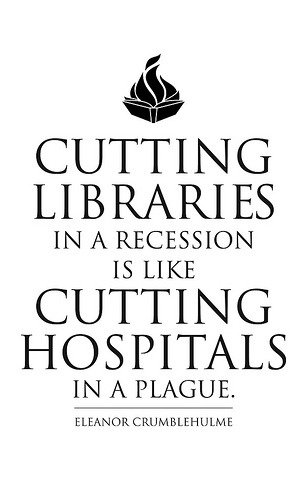
This image right here is one of the main reasons for this blog. Too often, libraries are seen as luxuries, or something to be cut because only a segment of the population uses them. A lot of times, libraries and library users are invisible.
Free libraries, especially public libraries, perform an amazing array of civic services: educating the public, especially segments that lack the resources, or the educational opportunities of others, provide information about, and sometimes access to social services, job hunting assistance, tax assistance, voting information and registration, the acquiring of new marketable skills, medical information, car manuals to allow people to perform their own work on their vehicles, guides to gardening, mental, emotional and relationship health, parenting, coping with disabilities, animal care, and a million other topics and services.
Everything from teaching basic computer skills to help someone fill out online applications to providing information on what social services are available, and how to reach the various offices. But we don't really like THOSE people, the unwashed masses--the underprivileged. Even those who need the guidance and reference assistance that a librarian can provide to point them in the right direction are looked down upon in this society.
We believe that people should "do for themselves," but we don't want to provide even the barest of means for them to do so. The library used to be the great equalizer. If one could read (or was willing to attend literacy classes at the library), and had the motivation to learn on one's own, great things were possible with the aid of a library. I won't put rose colored glasses on the past, and say that this was some beautiful golden age, but libraries WERE at the center of the community, and were available for people to better themselves.
I think taking that away, or reducing access and services is hurting the people we always hurt most with budget and program cuts--the most vulnerable of our population. Libraries are one of the many ways we provide a hand up to those in need. Honestly--I wouldn't be literate and educated without libraries. I grew up extremely disadvantaged. Access to books on any topic that struck my fancy fostered a love for learning and a thirst for knowledge I wouldn't have, otherwise.
Some arguments include that less people are using the library, etc. It's my belief that we should be promoting library usage. And it shouldn't just be the job of the librarian to get the word out into the community that the library is a community hub, but the library should have the support of the local government and community leaders to promote the value and use of the library to the people of its' community. If the city does not treat the library as a valuable and valued resource, the people of the community certainly will not. Some libraries are greatly involved in the cultural life of their communities. The Carnegie Library in Pittsburgh, PA is one place I can think of off the top of my head. The involvement goes both ways--the library reaches out, but other institutions reach toward the library to keep it an important community asset.
Running a library properly, and in a manner that keeps it a viable community resource costs money. I know that is tough to come by in these times. However, like education, I wonder what the cost is of NOT having a vibrant library program, and I suspect it is one we may not feel the full effects of now. We will be much further down the road, ten or twenty years' time, perhaps, before we see what we've wrought.
What happens when we don't foster a curiosity and a love of learning in our children at a young age? What happens if we don't teach them, through use, how to find the answers and resources that they're looking for, and are available to them in a library? What happens when we take away job and social resources from people on the verge of either breaking out of their situation, or slipping more permanently into decline? Will we even recognize WHY this has happened, or blame it on the victims, instead of the people who had the power to make a difference and chose to save a meager few thousand dollars on a line item in a budget? I'm afraid we may not figure it out until its too late.
Need some advocacy swag?

Check out the Library Advocacy Cafe Press store!
Most of the librarians I know are cool, hip information professionals who love a bit of humor and GenX irony, which makes this Cafe Press store a lot of fun, and has the potential for a lot of impact.

Do you run this Cafe Press site? Want to talk to us about your effort? E-mail me at TammyLGarrison at gmail dot com.
Tuesday, May 3, 2011
Activisim...you're doing it right
One of my peeves is that librarians talk a good game about activism, but are seldom as effective as they could be. So maybe I can interest you in this write-up from That Penguin Girl on Tumblr about how one librarian is reaching out to the larger world (he got the Old Spice Guy to do a video promoting libraries, and even campaigned to get Ben and Jerry's to do a flavor called the "Gooey Decimal System"), and is also doing his best to make the lot of patrons and librarians way more fair in regards to e-book lending.
Click here to read more about Dan, the Super Librarian, an inspiration to us all!
Click here to read more about Dan, the Super Librarian, an inspiration to us all!
Subscribe to:
Posts (Atom)